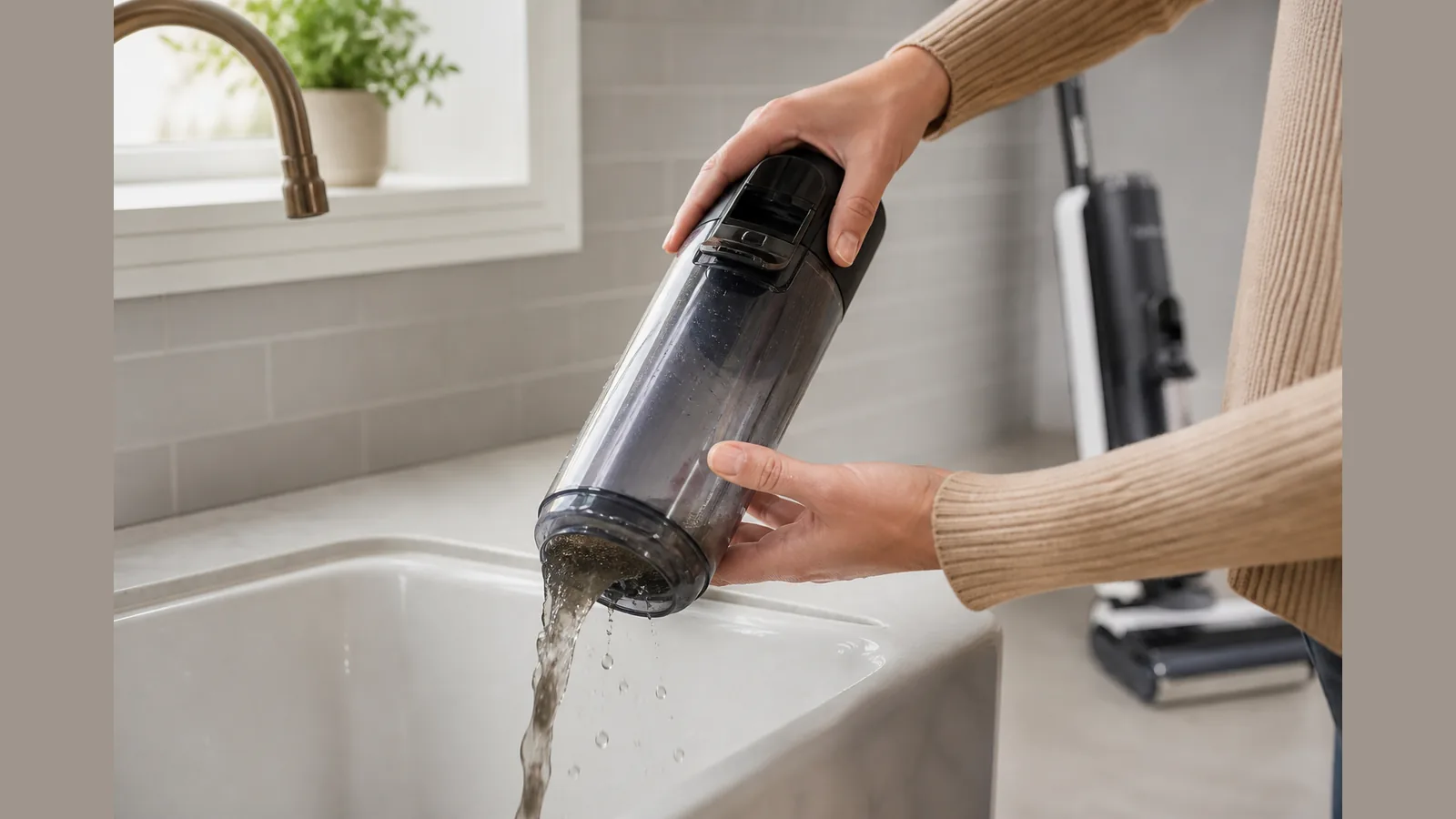
empty dirty water tank after every wet dry clean uk
For UK wet-dry floor cleaners, empty the dirty water tank after every wet dry clean as standard hygiene practice: leave soiled water sitting and you risk stale odours, residue build-up and a less pleasant next session.
Direct answer: empty dirty water after each session as standard hygiene practice
Manufacturer and floor-care guidance is consistent on this point. Dyson’s UK wet hard-floor cleaning guide recommends emptying dirty and clean tanks and clearing debris after cleans. Ideal Home’s vacuum-mop advice likewise notes that owners should keep clean tanks filled and empty dirty tanks after use. Treat post-clean tank emptying as non-negotiable routine, not an occasional deep-clean step.
Step checklist: park, empty dirty tank, rinse if needed, refill clean tank, run self-clean if the model has a dock cycle
- Park the machine safely — switch off and place it upright so tanks are easy to remove.
- Empty the dirty water tank — tip out the collected water and debris after every session, or sooner if the tank is full during a longer clean.
- Rinse if needed — if the dirty tank looks filmed or gritty, rinse it with clean water before refitting.
- Refill the clean tank — top up ready for the next use so you are not mopping with a near-empty clean reservoir.
- Run self-clean if your model has a dock cycle — cordless wet-dry designs that separate clean and dirty water often include a dock self-clean mode after use; follow your model’s dock steps when available.
Dyson’s guidance also stresses emptying the clean tank after use to reduce mould risk in standing water — a useful companion habit alongside dirty-tank emptying.
Why twin tanks matter vs grey mop water
Vacuum mops typically pick up dry and wet debris in one pass with rotating rollers and dual tanks. Cordless hard-floor cleaners in this category vacuum and mop wet and dry messes together while keeping clean and dirty water separate. That separation is the point: you apply fresh solution from the clean tank and recover soiled liquid into the dirty tank, instead of reusing the grey water a traditional mop bucket leaves behind. Emptying the dirty tank after each clean protects that advantage — otherwise yesterday’s recovery water sits ready to smell and splash residue next time you open the machine.
Smell-prevention habits without medical claims
- Empty the dirty tank after every session; do not leave soiled water overnight.
- Empty the clean tank after use when you will not clean again soon, so unused water is not left standing.
- Rinse the dirty tank when residue is visible, then leave parts to air-dry before reassembly if your routine allows.
- Clear debris from the tank area after cleans, as recommended in wet hard-floor care guides.
- Use the machine on suitable sealed hard floors only; domestic wet-dry units are not for floodwater or plaster dust.
These habits focus on ordinary freshness and hygiene of the appliance — not on treating illness or making antibacterial claims.
Link softly to product ownership features only as shown on live page
If you own or are considering a dual-tank cordless wet-dry vacuum mop, match your end-of-clean routine to the features actually listed for your model. On the FLOOR ONE S5 product details, the live page presents a cordless wet-dry vacuum mop for sealed hard floors, with dual tanks, self-clean dock positioning, and edge-oriented brush-head wording as published on-page. Use those ownership cues — empty both water paths, then use the dock self-clean positioning when your unit supports it — without assuming timings, temperatures or performance figures that are not stated there.
For a closer look at how that dual-tank and dock layout is described for UK owners, see the current FLOOR ONE S5 product details.
FAQ
How often should I empty the dirty water tank?
After every wet-dry clean as standard practice, and during a session if the dirty tank becomes full.
Should I also empty the clean water tank?
Yes when you have finished cleaning for the day: empty the clean tank after use to avoid leaving water standing, which floor-care guidance links to mould risk.
Do twin tanks replace emptying?
No. Separate clean and dirty tanks stop you mopping with grey bucket water, but the dirty tank still holds recovered soil and must be emptied after use.
When should I run a dock self-clean cycle?
After cleaning, if your model includes a dock self-clean mode — a common feature on cordless hard-floor machines that keep clean and dirty water apart.
What floors are these routines for?
Sealed hard floors such as tile, stone, sealed wood, ceramic, vinyl, linoleum and laminate, as listed in UK wet hard-floor guidance — not floodwater, plaster dust or as a full substitute for carpet cleaning.